
Voting in German elections from the United States

There is no voting at German consulates. Germans abroad vote by post, and the postal ballot only comes once the municipality has put you on its electoral register. The Federal Returning Officer explains the whole procedure on its page for Germans abroad.
If you are only abroad for a while and are still registered at a German address, none of this applies. You are on the register automatically and can ask your municipality for a postal ballot like any other voter.
Who can vote from abroad
Adult Germans living permanently abroad can vote if they are not disqualified and meet one of two conditions, set in sections 12 and 13 of the Federal Elections Act.
The first is simple to check: after turning 14, you lived in Germany for an uninterrupted three months or more, and that stay falls within the last 25 years.
The second is for people who never lived there, or left long ago. You must have become familiar with the political situation in Germany personally and directly, and be affected by it. Reading German newspapers or watching German television from here does not count.
The municipality decides whether you qualify. If it refuses, you can object to the municipality in writing or in person, where your statement is taken down for the record, and then appeal to the constituency returning officer.
New procedure guides, by email
We’ll email you when we publish a new procedure guide. No ads, and you can unsubscribe at any time.
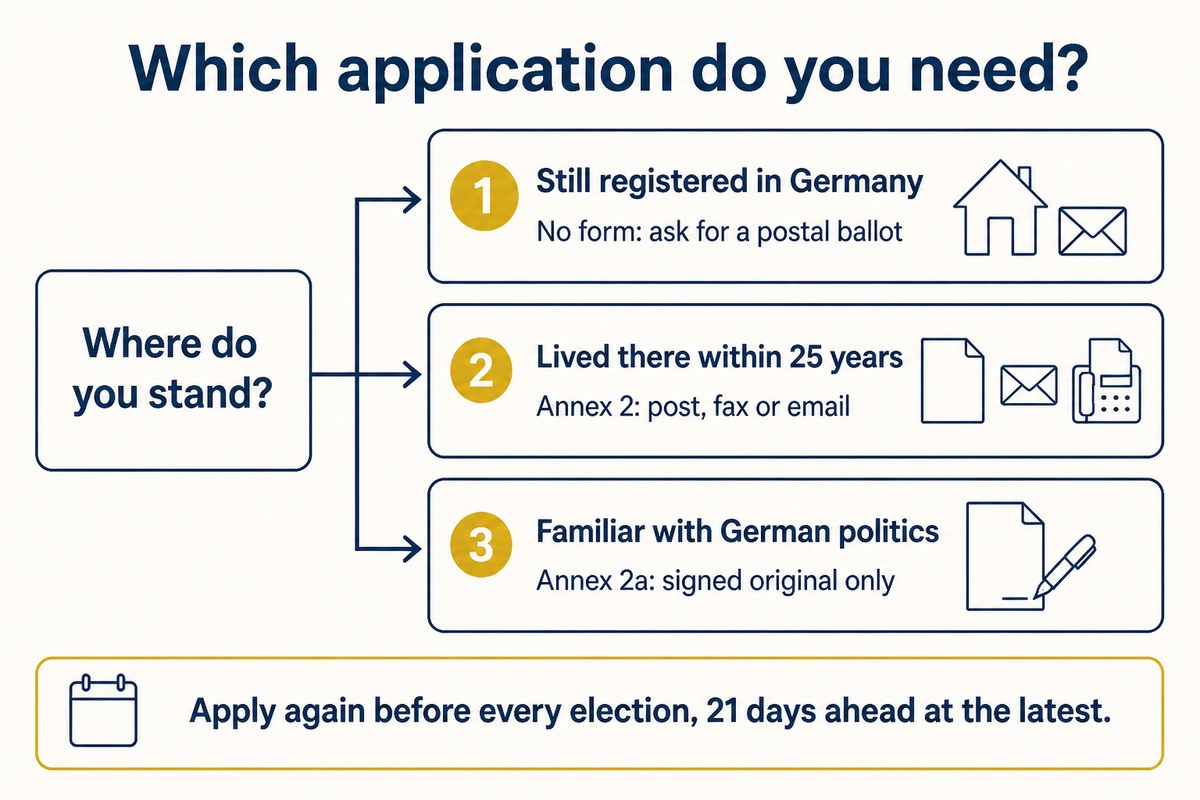
Which form is yours
Each condition has its own application, and the difference matters because of how it may be sent.
| Your situation | Form | How to send it |
|---|---|---|
| Lived in Germany for three months within the last 25 years | Annex 2 to the Federal Electoral Regulations | Original by post, or by fax, email or another verifiable electronic means |
| Familiar with and affected by German politics | Annex 2a | Original only: not by email or fax |
| Still registered at an address in Germany | None | You are on the register already; ask for a postal ballot |
Both forms need your personal, handwritten signature. The Federal Returning Officer suggests downloading the PDF and filling it in with full PDF software; on iPhones and iPads the file may claim to be password-protected, so print it and fill it in by hand instead.
Where to send the application
To the municipality where you were last registered before moving abroad. In Berlin and Hamburg, that means the borough office (Bezirksamt) for your old district.
If you never lived in Germany, it is the municipality you are most closely connected with through the reasons you give in the application. Where no such place exists, it is the last home municipality of your direct ancestors, in today’s Germany.
Addresses are in the official list of municipalities of the Federal Statistical Office or on the town’s website. Schleswig-Holstein, Lower Saxony, Bremen, Saarland and Bavaria also offer an online search by your last address.
The deadline, and why it is strict
The municipality must receive the application by the 21st day before the election. That deadline cannot be extended; for the February 2025 election it was 2 February 2025.
The only exception is an application filed late through no fault of your own, which you have to prove. Send it as soon as an election is called, because the postal voting pack can only be mailed once the ballot papers are printed, and an early election shortens all of that.
Do not wait for a confirmation. Municipalities usually do not send one, and the application doubles as the request for your polling card, so the postal ballot simply arrives.
Getting the ballot back in time
Your ballot letter has to reach the election office in Germany by 6 p.m. on election day. From the United States, ordinary mail can be slow, and the German missions here offer an alternative.
For the 2025 election, the embassy in Washington and the consulates general in Atlanta, Boston, Chicago, Houston, Los Angeles, Miami, New York and San Francisco were all on the Federal Returning Officer’s list of missions accepting ballot letters for the official courier service.
That list is dated 7 February 2025, and a new one comes out for each election, so check it before you count on your mission. Ballot letters need no stamp.
The courier has its own cut-off: for the 2025 election, letters had to be at the Federal Foreign Office in Berlin by the Thursday before the vote. Ask your mission how early it needs yours. Letters cannot be tracked, and the Foreign Office accepts no liability for late ones.
Express services or airmail may be faster. That choice, and the postage, are yours.
To hear about election dates and deadlines in time, the Federal Returning Officer suggests registering on the Federal Foreign Office’s ELEFAND crisis preparedness list, whose members are told about upcoming elections.
Frequently asked questions
Can I vote at the German consulate?
No. Polling stations are not set up at missions abroad. Germans abroad vote by post after joining the electoral register.
Do I have to register again for every election?
Yes. It is the only way the municipality gets your current address to mail the postal voting pack.
Can I email the application?
Only the Annex 2 form, for people who lived in Germany within the last 25 years. The Annex 2a form must reach the municipality as a signed original.
Which municipality is responsible?
The one where you were last registered before leaving Germany, or, if you never lived there, the one you are most closely connected with.
Do dual citizens living in the US get to vote?
The rules apply to Germans, so a German citizen who also holds US citizenship applies like anyone else. See dual citizenship if you are unsure whether you are still German, and the certificate of citizenship for the document that proves it.
- The right form: Annex 2 or Annex 2a
- Your handwritten signature on it
- The address of your last German municipality
- The election date, to count back 21 days
- A plan for returning the ballot: mail, express or your mission’s courier