
German certificate of inheritance (Erbschein) from the US

German law has no executor in the American sense. The heirs own the estate in Germany from the moment of death, and they prove it with an Erbschein, which is required before they can dispose of real estate or bank assets (germany.info, inheritance matters).
The certificate is issued by a probate court, the Nachlassgericht. That is usually the court for the deceased’s last residence in Germany or, if they did not live there, the court where the assets are.
Who applies
At least one heir has to apply, with an affidavit (a declaration in lieu of oath). In special circumstances the executor or trustee named in an American will can also apply. One applicant applies in the name of all the heirs and needs no power of attorney from the others.
The application can go to the probate court directly if there are heirs in Germany, to a German notary, or through a German mission abroad. For heirs living in the US, the mission is the route this guide covers.
New procedure guides, by email
We’ll email you when we publish a new procedure guide. No ads, and you can unsubscribe at any time.
How the mission handles it
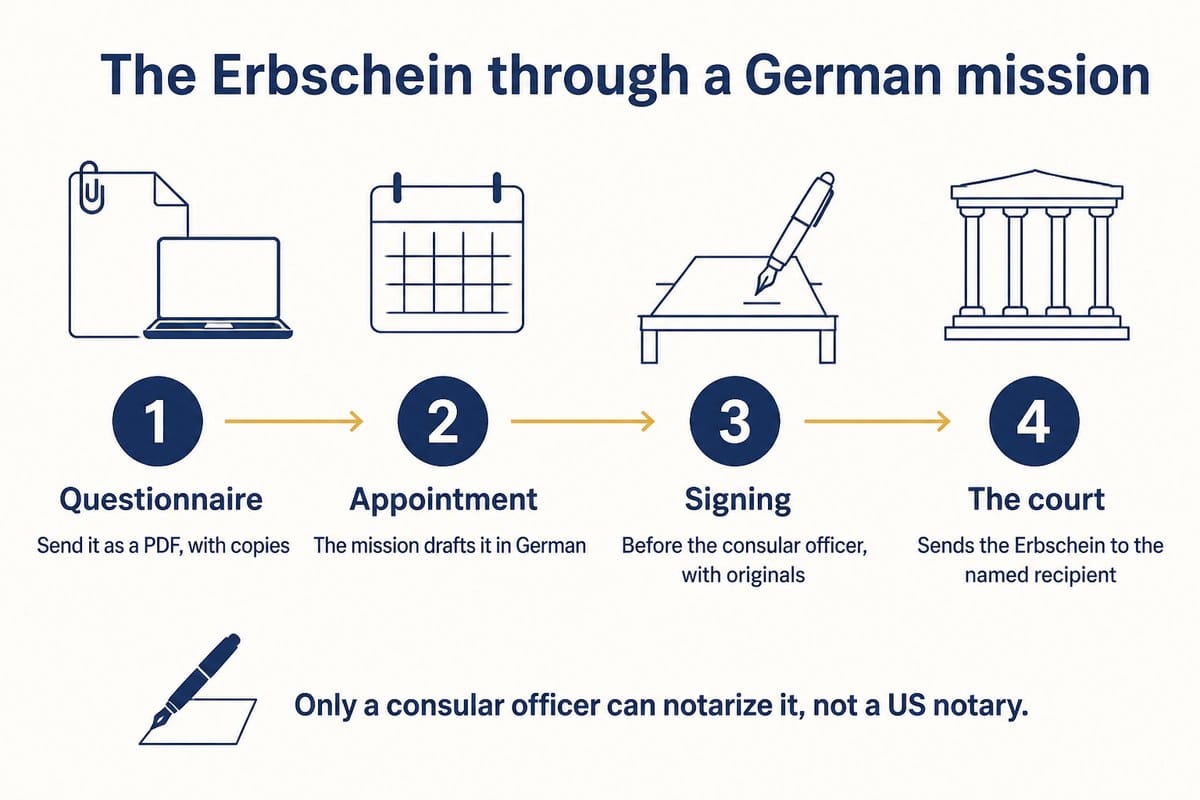
germany.info sets out four steps. The work starts before any appointment: the mission needs everything in advance to draft a formal application.
| Step | What happens |
|---|---|
| 1. Questionnaire | You fill out the inheritance questionnaire and send it as a PDF, with copies of the papers that prove the right to inherit |
| 2. Appointment | The mission drafts the application in German and contacts you to set an appointment to sign it |
| 3. Signing | You sign before the consular officer, show the originals, and leave with the original and a first certified copy |
| 4. The court | One of them goes to the probate court, or to your representative in Germany, and the court sends the Erbschein to the recipient named in the application |
The application is written only in German, the official language. If you do not understand it, the consular officer explains it and translates it orally at the appointment; a written English translation is at your own cost.
Bring the originals of every document you copied for the questionnaire. The mission certifies the copies there, so the court receives a complete file.
The documents
germany.info recommends enclosing copies of everything that proves the right to inherit. It gives these examples: the last will, letters testamentary, death certificates, birth certificates and marriage certificates.
For the appointment itself, the notarization rules ask for a valid photo ID: a passport, a German ID card or a US driver’s license (germany.info, certifications and notarizations). If you sign for someone else, such as a ward, you also bring proof that you can act for them.
If a German birth or marriage record is missing from the family file, our guide to a birth certificate from Germany explains how to order one from the registry office.
Fees and payment
The mission charges up to 300 euros for preparing the application, affidavit included, and up to 157 euros for the certification. The exact amount depends on the case, and germany.info sends you to the mission’s contact form to ask.
You pay in cash in US dollars at the day’s exchange rate, or by Visa or Mastercard, which is charged in euros. The probate court in Germany sets its own costs for issuing the Erbschein; the mission’s page does not list them.
Only a consular officer can take it
The application for a certificate of inheritance is one of the acts that a consular officer has to notarize. A German honorary consul cannot do it, and neither can a US notary public, which is different from a simple signature certification.
Not every consular officer in the US is authorized for it, so check with the mission that serves your state before you send the questionnaire. Each of these appointments is individual and has to be prepared. Our appointments page lists the nine missions and where each one publishes its hours.
Some documents cannot be notarized at German missions in the US at all, among them wills and inheritance contracts. For those you need a notary in Germany.
Turning down an inheritance
An heir can renounce the succession by declaring it to the probate court. The deadline is six weeks, or six months if the heir lives outside Germany, counted from when you learn of the inheritance.
Here a signature certification is enough, so a consular officer or an honorary consul can take it, and you then send the declaration to the court yourself. The fee is 60 euros. For a minor child, both parents declare on the child’s behalf, or one if they have sole custody.
Our guide to apostilles, notarizations and certified copies explains when a signature certification is enough and where apostilles come from.
Frequently asked questions
What does Erbschein mean in English?
Certificate of inheritance. It is the court document that names the heirs and lets them dispose of the estate in Germany.
Do I have to travel to Germany?
No. The mission that serves your state drafts the application and takes your signature, and you send it on to the court in Germany.
Can a US notary do it?
Not for the Erbschein application: germany.info says it has to be notarized by a consular officer. A US notary can usually certify other signatures, such as a simple power of attorney, sometimes with an apostille on top.
Is there inheritance tax in Germany?
Germany taxes inheritances and gifts, and a 1982 convention with the US avoids taxing the same estate twice. In the US it covers only federal estate and gift tax, not state taxes, and germany.info advises asking a tax expert (germany.info, double taxation of estates).
How long do I have to renounce?
Six months from when you learn of the inheritance if you live outside Germany, six weeks if you live there.
Ask the mission for your state whether its consular officer can notarize the Erbschein application before you fill out the questionnaire.- The inheritance questionnaire from germany.info, as a PDF
- Copies of the will, death, birth and marriage certificates
- The originals, for the appointment
- A passport, German ID card or US driver’s license
- Cash or a Visa or Mastercard for the fee