
German citizenship by descent

Around 45 million people in the United States report German ancestry, and a steady share of them go looking for a passport. The answer usually turns on a single question: what did the law say in the year your ancestor left, and did anything interrupt the chain after that.
The ten-year rule that broke most American lines
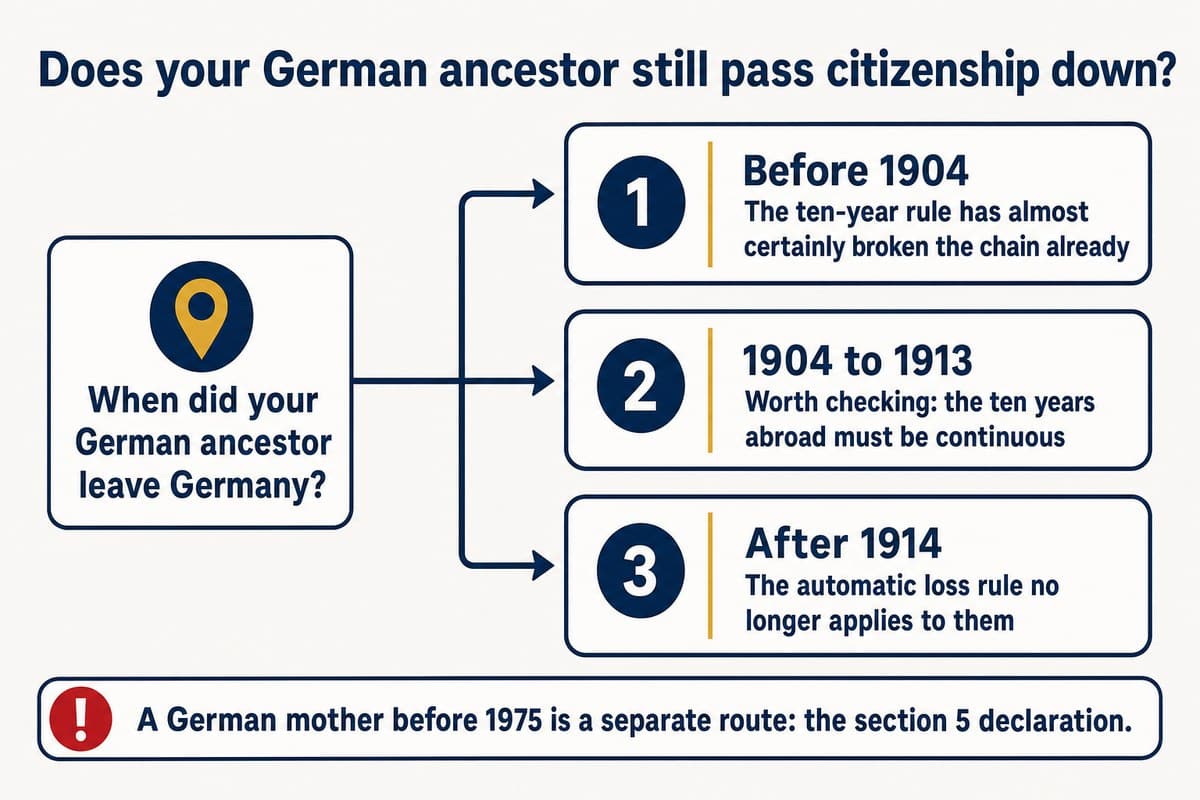
Under the German Citizenship Act as it stood from 1871 to 1914, a German who lived outside the country for more than ten years lost German citizenship automatically. No decision, no letter, no record.
That covers the great emigration waves of the nineteenth century. The Federal Foreign Office puts it plainly: a claim based on an ancestor who arrived in the United States before 1904 will usually fail.
It is worth checking anyway if the ancestor kept moving back and forth, or returned to Germany at some point, because the ten years have to be continuous.
What actually passes citizenship down
Citizenship in German law follows descent, not birthplace. A child born anywhere to a German parent is German from birth, provided the parent was still German at that moment.
Before 1 January 1975 the rules were not symmetrical: children born in wedlock took the father's citizenship, and a German mother married to a foreigner did not pass hers on. Several later laws opened routes for the people that rule excluded.
The route for them is a declaration under section 5 of the Citizenship Act, not an application for naturalization. It is a different form and a different legal footing.
A separate route exists for descendants of people persecuted by the Nazi regime on political, racial or religious grounds. That one sits in article 116 of the Basic Law and has no deadline.
How you prove it, and who decides
The document that settles the question is the certificate of citizenship, the Staatsangehörigkeitsausweis. Nothing else proves German citizenship, and a passport is not proof of it either.
The decision is taken in Cologne by the Federal Office of Administration, not by the consulate. The consulate checks your file and forwards it.
Expect the evidence to run to birth, marriage and death records for every generation in the chain, in the original. Gaps are what make these cases take years.
What the dates mean for your case
| Your ancestor left Germany | What usually follows |
|---|---|
| Before 1904 | The ten-year rule has almost certainly broken the chain already |
| 1904 to 1913 | Worth checking: the ten years must be continuous |
| After 1914 | The automatic loss rule no longer applies |
| Born abroad before 1 Jan 1975, German mother | Look at the section 5 declaration, not at naturalization |
| Family persecuted 1933 to 1945 | Article 116 of the Basic Law, and there is no deadline |
Which case applies to you
- Birth, marriage and death certificates for every generation in the chain
- The emigration date, as precisely as you can pin it down
- Any German passport, military record or registration document in the family
- Naturalization records for the ancestor, including the date
- Certified translations where the documents are not in German