
Visas for Germany from the United States

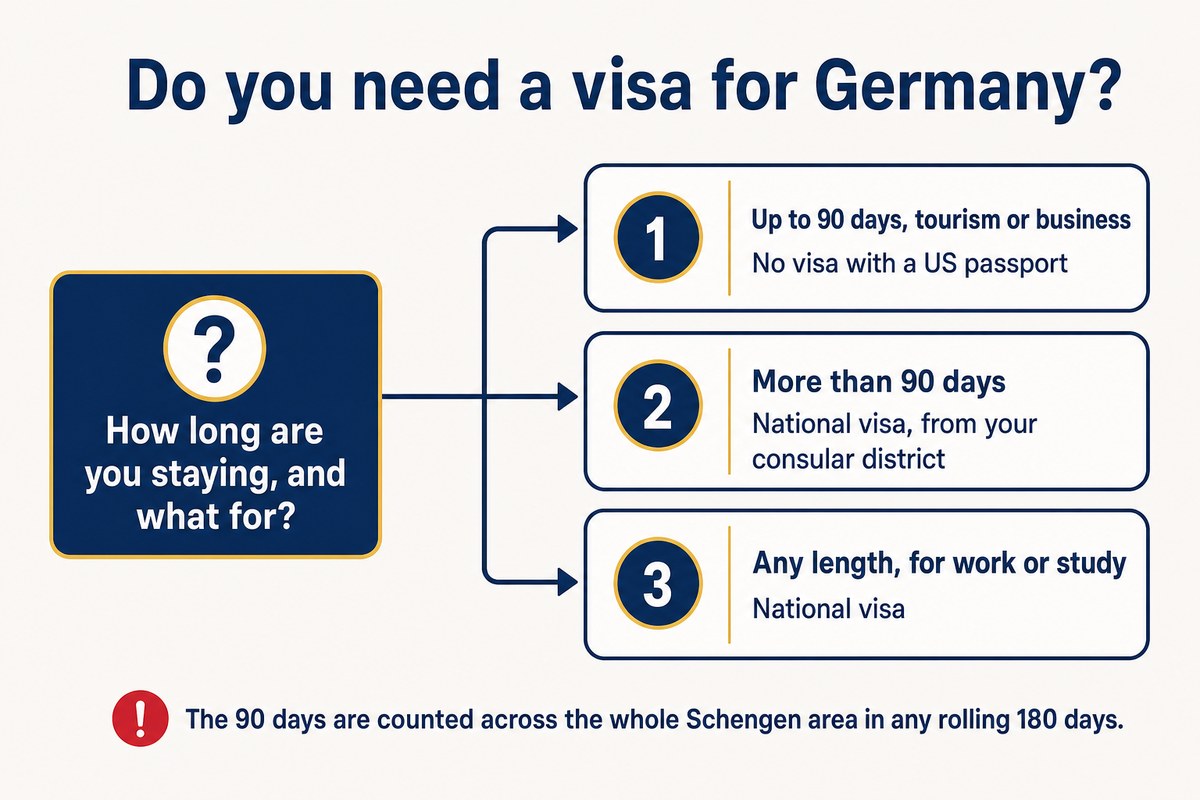
Germany is in the Schengen area, so the rules that matter are Schengen rules. The line that decides everything is 90 days: below it, US citizens travel visa-free, and above it the application is a national visa handled by the mission that covers your state.
When you do not need one
A US passport holder can enter for up to 90 days in any 180-day period without a visa, for tourism, family visits or business meetings.
The 180 days roll: the clock is not calendar-based, and it counts days anywhere in the Schengen area rather than in Germany alone.
Green card holders are not covered by that. Your nationality decides whether you need a visa, and your US residence decides which mission handles it.
When you do
Anything over 90 days is a national visa, and so is anything involving work, study or joining family, even for a shorter stay.
The application goes to the mission that covers the state you live in, and the consular districts here are not negotiable. Applying to a mission that does not cover you wastes the appointment.
An airport transit visa is a separate category and applies to a short list of nationalities passing through a German airport without entering.
None of this touches German citizenship. If a German parent or grandparent is the reason for the trip, check citizenship by descent first: a German passport removes the visa question entirely.
What decides the timeline
National visa decisions involve authorities in Germany, so they take considerably longer than a Schengen visa would. Months, not weeks.
Appointment availability is the first bottleneck and it varies a great deal between missions. Houston, for instance, runs its visa hotline for ninety minutes a week.
Start with the mission's own page for your category. Requirements for a work visa and a student visa overlap only partly.
Which route applies
| Your plan | What you need |
|---|---|
| Tourism up to 90 days, US passport | No visa |
| Business meetings up to 90 days, US passport | No visa |
| More than 90 days | National visa, from your consular district |
| Work or study of any length | National visa |
| Joining a family member in Germany | National visa |
| Not a US citizen, living in the US | Depends on your nationality; the mission is decided by where you live |
Which case applies to you
- A passport valid for at least three months beyond your departure
- Proof of the purpose: enrolment letter, employment contract, family papers
- Proof of health insurance valid in Germany
- Proof of accommodation and of means of support
- The application form for your specific visa category